
There are two types of women when it comes to AI.
The first has seventeen browser tabs open, three half-finished courses she swears she’ll complete “when things calm down,” and a growing sense of dread every time someone mentions a new tool she’s never heard of. She’s trying. God, she’s trying. But the trying itself has become exhausting.
The second uses maybe two or three tools. She doesn’t know what dropped last Tuesday in the AI world, and frankly, she doesn’t care. She made her decisions months ago and hasn’t looked back. When someone asks what AI she’s using, she doesn’t panic or apologise. She just… tells them.
Here’s the thing nobody talks about: the second woman isn’t more technically skilled. She’s not smarter. She hasn’t cracked some secret code.
She’s just decided to stop performing confidence and start actually having it.
The Quiet Reality of AI Confidence for Women in Business
Confident AI use doesn’t look like what you think it looks like.
It’s not posting about your tech stack on LinkedIn. It’s not having opinions about every new release. It’s not being the first to try everything or the loudest voice in the room about automation.
It looks like… nothing, really. That’s the point.
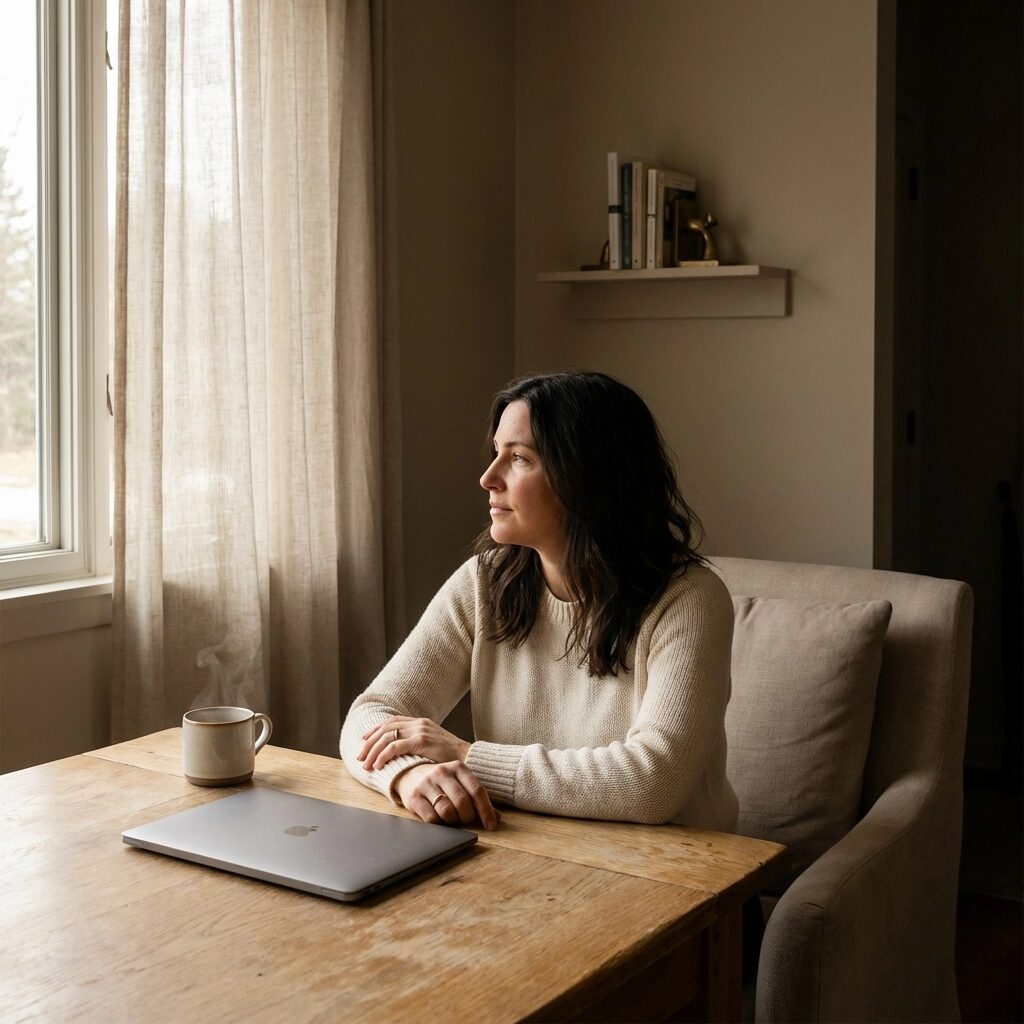
It looks like a woman running her business on a Tuesday afternoon, using the same tools she used last month, not wondering if she’s missing out. It looks like closing a tab instead of bookmarking it “for later.” It looks like hearing about a shiny new platform and thinking, “Good for them,” and then getting back to work.
Using AI calmly isn’t a personality trait you’re born with. It’s a series of small decisions that add up to something bigger: trust in yourself.
Fewer Tools, More Peace
Here’s a truth that might sting a little: the women who seem most confident with AI typically use fewer tools than everyone else.
Not because they can’t handle more. Because they’ve realised that more isn’t better. More is just… more.
Think about your kitchen for a second. You probably have a drawer full of gadgets, the avocado slicer, the egg separator, the thing that’s supposed to make spiralised courgettes enjoyable (it doesn’t). But when you actually cook? You reach for the same knife, the same pan, the same wooden spoon your nan probably used.
AI works the same way.
The confident woman has her version of the wooden spoon. Maybe it’s ChatGPT for brainstorming. Maybe it’s one scheduling tool and a simple automation. Whatever it is, she knows it well, she trusts it, and she’s not constantly wondering if something else would be better.
Because here’s what nobody tells you: tool-hopping is a symptom of anxiety, not curiosity. Every time you switch to something new “just to try it,” you’re resetting the clock on actually getting good at anything.
AI decision confidence comes from commitment, not exploration.
The “Decide Once” Principle
You know that feeling when you’ve finally picked a restaurant, everyone’s agreed, and then someone pulls out their phone to check reviews “just in case”?
That’s what most women do with AI. Constantly.
They pick a tool, start using it, and then immediately begin second-guessing. What if there’s something better? What if they chose wrong? What if everyone else knows something they don’t?

Confident women decide once.
Not because they’re certain they’ve made the perfect choice, perfection doesn’t exist, but because they understand something crucial: the cost of constant switching is higher than the cost of sticking with “good enough.”
Every hour you spend researching alternatives is an hour you’re not spending actually using what you have. Every moment of doubt is energy that could go toward your actual business.
So they decide. And then they defend that decision, not to anyone else, but to themselves. When the next shiny thing appears (and it will, probably before you finish reading this), they don’t spiral. They simply think, “I’ve already made this decision,” and move on.
It sounds almost too simple. That’s because it is.
Updates Don’t Require Panic
Let’s talk about the AI news cycle for a second.
Every week, sometimes every day, there’s something new. A feature. A tool. A breathless headline about how everything’s about to change. Again.
If you’re paying attention to all of it, you’re exhausted. You’re meant to be exhausted. That’s how the attention economy works.
But here’s what confident women have figured out: updates don’t require action.
Just because something exists doesn’t mean you need to use it. Just because something changed doesn’t mean your approach needs to change. Just because someone on the internet is excited doesn’t mean you need to be excited too.
AI without overwhelm is possible. But it requires something uncomfortable: being okay with not knowing everything.
The woman who’s using AI calmly isn’t checking tech news every morning. She’s not in twelve Facebook groups about the latest releases. She’s not anxious about falling behind because she’s rejected the entire premise that there’s a “behind” to fall to.
She trusts that if something genuinely important happens, something that actually affects her business, she’ll hear about it eventually. And “eventually” is soon enough.
Trusting Your Own Judgement
This is where it gets personal.
Most AI overwhelm isn’t really about AI. It’s about trust. Specifically, not trusting yourself to make good decisions without external validation.
You want someone to tell you which tool is “the best.” You want a definitive answer. You want permission to stop looking and start doing.
But confident AI use doesn’t come from finding the right answer. It comes from trusting that your answer is right enough.
Your business is different from everyone else’s. Your brain works differently. Your clients have different needs. The tool that transforms someone else’s workflow might be completely wrong for you, and that’s not a failure. That’s just reality.
The women who’ve cracked this aren’t smarter or more experienced. They’ve just stopped outsourcing their judgement to strangers on the internet. They try something, they assess whether it works for them (not whether it works for everyone), and they trust their own conclusions.
Sound simple? It is. Sound easy? It’s absolutely not.
What This Actually Looks Like Day-to-Day
Let me paint you a picture of AI confidence for women in business in practice.
It’s Wednesday. You’ve got client work to do. You open the same AI tool you opened yesterday, not because you’ve researched it recently, but because it works and you can’t be bothered to think about it anymore.
You use it for the thing you always use it for. It helps. You close it. You don’t wonder if you’re “using it right” or “getting the most out of it.” You just… move on with your day.
Someone mentions a new tool at a networking event. You smile, nod, say “Oh interesting,” and immediately forget about it because you weren’t looking for a new tool. Your life is not a problem that needs solving with more software.
An email lands about “10 AI Tools Every Business Owner Needs in 2026.” You delete it without opening it. Not because you’re arrogant, but because you know: deep in your bones: that you don’t need ten of anything.
That’s it. That’s the whole thing.
No drama. No performance. No constant optimisation. Just a woman running her business, using technology that serves her, and refusing to let the noise dictate her peace.
Permission to Be Boring
Here’s your permission slip, if you need one:
You don’t have to be excited about AI. You don’t have to have opinions about it. You don’t have to keep up, stay current, or care about what dropped this week.
You can be boring about it. You can use the same three tools for years. You can shrug when people ask what you’re using and say, “Just the basics, really.”
Confident use of AI isn’t about mastery. It’s about peace. It’s about building a relationship with technology that serves your business without consuming your mental energy.
And that, honestly, is available to you right now. Today. Without learning anything new.
You just have to decide that what you have is enough. And then defend that decision like your sanity depends on it.
Because, quietly, it does.