
Operational resilience for small business is not about waiting for a disaster to strike or having a survivalist bunker for your laptop; it is about building a company that stays upright when life, in all its messy glory, decides to interrupt your carefully colour-coded calendar. Implementing operational resilience for small business means you are no longer the single point of failure in your own success story. The goal is to design operational resilience for small business so that your revenue, your reputation, and your sanity remain intact, even when your attention is elsewhere.
Stop Building Businesses That Only Work During Perfect Weeks
We have all had them. Those rare, shimmering weeks where the children are magically self-sufficient, the Wi-Fi doesn’t drop during a masterclass, and you actually finish your to-do list by 4:00 PM. We tend to build our business models around these “perfect weeks.” We assume that our capacity will always be at 100%, that our energy will be infinite, and that the world will politely wait its turn before demanding our attention.
But perfect weeks are a terrible foundation for a sustainable business.
The real test of your business doesn’t happen when everything is calm. The real test happens when the school holidays begin, when a family member suddenly needs your help, or when a 48-hour power cut turns your kitchen into a dark, slightly damp negotiation zone. If your business only works when you are at your best, you haven’t built a company: you’ve built a very high-pressure job that is constantly one minor crisis away from a standstill. This is where founder overwhelm begins to settle in, not because you aren’t working hard enough, but because the business is too fragile to breathe on its own.
What Operational Resilience Actually Means
In plain English, operational resilience means the business keeps moving when you stop. It’s the difference between a bicycle that falls over the second you let go of the handlebars and a self-righting system that maintains its path.
It isn’t about being perfect. It isn’t about eliminating every possible disruption (spoiler: you can’t). It’s about reducing dependency. When we talk about sustainable business growth, we are talking about building a structure that can survive the founder’s absence. If a client enquiry sits in an inbox for four days because you were dealing with a family emergency, that’s a resilience failure. If your marketing goes dark for a month because you took a holiday, that’s a design weakness. Resilience is simply the art of ensuring that “Value Delivered” is not a direct variable of “Founder Energy Spent.”
Why We Keep Building Businesses Around Ourselves
Most of us start as “solopreneurs,” a word that sounds much more glamorous than it feels when you’re the one doing the bookkeeping at 11:00 PM. In the beginning, you are the business. You are the CEO, the intern, the marketing department, and the person who remembers to buy the oat milk.
The problem is that we often grow faster than our systems. We carry the entire operation in our heads. We believe: sometimes secretly, sometimes loudly: that nobody else can do it quite like we can. We hoard knowledge like a suspicious cat with a favourite toy. This isn’t laziness or a lack of discipline; it’s a deep sense of responsibility. But that responsibility becomes a cage. When every small decision requires your input, you haven’t built a business; you’ve built a bottleneck.

Summer Holidays Reveal Everything
The start of the school summer holidays is the ultimate “reveal” for many women in business. Suddenly, the quiet hours of the morning are replaced by the logistics of snack boxes and “I’m bored” refrains. Within 72 hours, the cracks begin to show.
- Marketing pauses: Because if you don’t post, nobody does.
- Networking disappears: Because you don’t have the three hours needed to “just pop onto LinkedIn.”
- Follow-ups slow down: Because they were stored in your memory, not a system.
- Admin builds up: Like a slow-moving landslide in your inbox.
The holidays didn’t create these weaknesses. They just stripped away the “perfect week” illusion that was masking them. It’s a vivid reminder that building businesses around real life requires more than just a good intentions; it requires a structural shift.
Strong Businesses Expect Different Seasons
Living in a rural area, I’m constantly reminded of the harvest. I watch the farmers move with an intensity that would be unsustainable in February. They don’t expect the harvest season to look like winter, and nature doesn’t expect the soil to produce at the same pace every single month.
Your business should be the same. Operational resilience for small business means acknowledging that you will have high-intensity “harvest” seasons and quiet “winter” seasons. A resilient business flexes. It uses the quiet periods to build the systems that will carry the load during the busy ones. Instead of resisting the change in pace, a resilient founder designs for it.
“Operational resilience is designed, not discovered.”
Build Buffers Before You Need Them
An operational buffer is simply something that reduces the pressure before the pressure arrives. It’s the “emergency snack” in the glove box of your business. If you wait until you are overwhelmed to build a system, you are already too late.
Consider these practical buffers:
- Content Banks: Having 30 days of brand-matched posts ready to go so that a sick day doesn’t become a visibility crisis.
- Email Templates: Standardizing your common replies so you aren’t “re-inventing the wheel” for every enquiry.
- Onboarding Checklists: So a new client can be welcomed without you having to remember every single link and attachment.
- Automated Reminders: Letting the tech chase the invoices or the missing information.
- Documented Processes: Writing down the “how-to” so that someone else (or a future, tired version of you) can follow it.
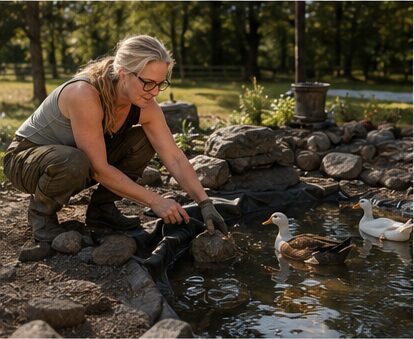
By implementing calm business systems, you are creating a “silent salesperson” that works while you are tending to the duck pond or, more likely, negotiating who gets the blue bowl for breakfast.
Stop Measuring Productivity. Start Measuring Recovery.
We are obsessed with constant productivity. We track billable hours and tick off tasks like our worth depends on it. But for a truly resilient business, the better metric is Recovery Speed.
How long does it take you to get back to “normal” after a week off? If it takes you three weeks of frantic catching up to recover from a seven-day holiday, your resilience is low. If you can step back in and find that the leads are still warm and the clients are still happy, you’ve built something that can breathe. The strongest businesses are not the ones that never stop; they are the ones that recover the fastest.
Where AI Fits
AI is often presented as the “hero” that will save your business. In reality, AI automation is just one very effective tool in your resilience kit. It shouldn’t replace your voice or your relationships, but it should absolutely replace your repetitive operational load.
AI can draft your standard communications, organize your scattered notes, and maintain consistency in your marketing when your brain is currently 85% occupied by school holiday logistics. The goal isn’t to look like a robot; it’s to use the robot to protect your human capacity for the things that actually matter: like deep work, creativity, and genuine connection.
Protecting Relationship Building
Relationship building is usually the first thing to die when life gets busy. We stop “scouting” for new connections because it feels like a luxury we can’t afford when we’re firefighting. But when you stop building relationships today, your pipeline for three months from now begins to dry up.
This is exactly why we created Connection Scout™. It’s an example of operational resilience in action. My team handles the time-consuming research on LinkedIn for you. We identify the people you should be talking to, so that when you do have twenty minutes of peace, you aren’t spending it searching: you’re spending it actually talking. It protects your LinkedIn visibility and momentum without you having to be glued to your phone while the kids are at the park.

Build a Business That Can Breathe
Resilience gives you breathing room. It’s the quiet confidence that the sky won’t fall if you don’t check your email by 9:02 AM. It allows you to be present for the life you actually wanted when you started this business in the first place.
“Calm isn’t the reward. Calm is the strategy.”
When your business has business systems that function independently of your minute-to-minute attention, you aren’t just more productive: you’re more free. You move from being the engine of the business to being the captain. One of those roles involves a lot more grease and exhaustion; the other involves a lot more vision.
Conclusion
The next time you feel that familiar rise of panic when a school holiday approaches or a client project grows arms and legs, don’t ask yourself, “Can I cope with this?” Instead, ask, “Is my business ready for this?”
Building operational resilience for small business is a gradual process of removing the stones that trip you up. It’s about admitting that perfect weeks are a myth and that your business needs to be as sturdy as a Belgian Draft horse and as flexible as the seasons. A resilient business doesn’t remove life’s interruptions; it simply refuses to let those interruptions become business crises. By focusing on operational resilience for small business, you are choosing a path that leads away from burnout and towards a business that truly supports you.
Ready to protect your momentum?
If maintaining your visibility and building new relationships is the first thing to drop when life gets busy, let us take the “search” off your plate. Connection Scout™ provides consistent, high-quality LinkedIn research and qualified connection identification, so you can focus on the conversations that matter.
Learn more about Connection Scout™ here – Limited introductory pricing starts from just £99 per month.
Not sure where to start?
Download our Calm AI Quick-Start Guide to identify exactly where your business could become more resilient through thoughtful automation and systems that actually work for your real life.