
There are two types of people who reorganise their sock drawer at 11pm on a Tuesday.
The first type genuinely needs organised socks. The second type needs to avoid looking at their overflowing inbox.
Both look productive. Only one is actually solving a problem.
When it comes to business systems, we’re often the second type, except we’ve convinced ourselves we’re the first. We’re colour-coding things that don’t need colour-coding. We’re building elaborate dashboards for tasks we do twice a year. We’re tweaking brand fonts while our follow-up process runs on hope and Post-it notes.
It’s procrastination dressed in responsible clothing. And it’s exhausting.
The Aesthetic Organisation Trap
Here’s the thing about cosmetic systems: they feel so good to create. There’s something deeply satisfying about a beautiful Notion template with matching icons. About a perfectly colour-coded calendar. About a branded PDF that looks like it belongs in a design museum.
But beautiful doesn’t mean functional.
I’ve watched clients spend three weeks perfecting a client onboarding workbook, custom illustrations, matching colours, the works, while manually copying and pasting the same email response seventeen times a day. The workbook got used twice. The email got sent three hundred times.
This is what I call productive avoidance. You’re working. You’re busy. You can point to tangible outputs. But you’re solving the wrong problem entirely.
The trap is that aesthetic organisation does create a sense of relief. Just not the kind that lasts. It soothes the discomfort of feeling overwhelmed. It doesn’t actually relieve the pressure causing the overwhelm.
There’s a difference.
What We Fix First (And Why It’s Wrong)
Women, especially, fall into three specific traps when they start building systems:
The Branding Trap
Tweaking logos. Adjusting colour palettes. Rewriting the About page for the fourteenth time. It feels like foundational work, doesn’t it? Like you can’t build proper systems until your brand is “right.”
Except your brand was fine six versions ago. What’s not fine is that you’re manually invoicing every client and forgetting half of them until they ask about payment.
The Rare Task Trap
Building elaborate systems for things you do quarterly. Creating detailed workflows for edge cases. Documenting processes for scenarios that might happen someday.
Meanwhile, the thing you do every single day, sending discovery call follow-ups, posting on social media, scheduling client sessions, runs on whatever you remember to do in the moment.
The Dashboard Trap
Oh, the dashboard trap. This one’s sneaky because it looks so strategic. You’re tracking metrics! You’re being data-driven! You’ve got widgets and integrations and colour-coded performance indicators!
But you’re not looking at it. Or worse, you’re spending an hour a week updating it manually to track something that doesn’t actually inform any decision you make.
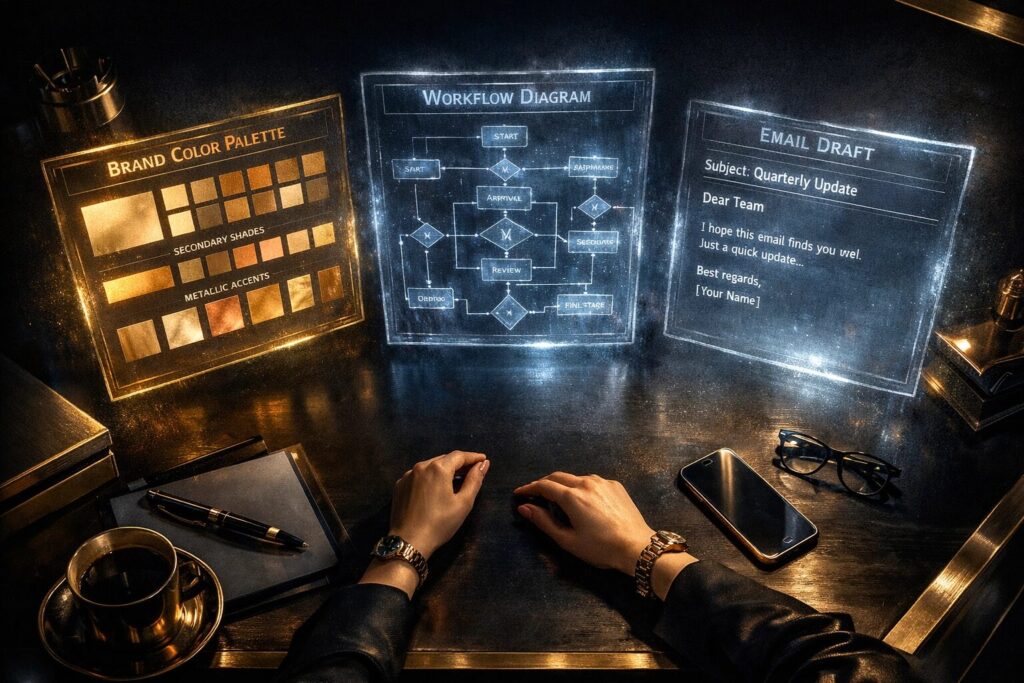
If you’ve ever found yourself thinking “I just need to get this organised first, then I’ll tackle the actual problem,” congratulations, you’re systemising the wrong things.
What Actually Creates Relief
Let me tell you about lead generation. Not the strategy part, the doing part.
Lead generation isn’t difficult. It’s just relentless.
Post on social media. Engage with comments. Follow up on warm leads. Nurture cold leads. Send value-building emails. Show up consistently. Track conversations. Remember context.
None of it is hard. All of it is constant.
This is where functional systems live, in the relentless, repetitive, energy-draining tasks that aren’t complicated but will absolutely deplete you if you’re doing them manually every single day.
Here’s what actually deserves your attention:
Follow-ups
You know what you need to follow up on. You probably have a list. What you don’t have is a system that reminds you, templates the message, and tracks whether you’ve done it. So half your follow-ups happen three weeks late, and the other half don’t happen at all.
Lead Generation
The daily presence work. The content creation. The engagement. This is where “just be consistent” meets “but I’m exhausted.” A good system doesn’t make the work disappear, it makes it possible to do without thinking about how to do it.
Scheduling
If you’re still playing calendar tennis with clients (“Does Tuesday work?” “No, but Thursday?” “Morning or afternoon?” “Actually, can we do next week?”), you’re spending cognitive load on something that should take thirty seconds.
Onboarding
The questions are always the same. The information you need is always the same. The welcome email you send is always… well, it’s supposed to be the same, but you’ve sent fourteen different versions because you keep writing them from scratch.
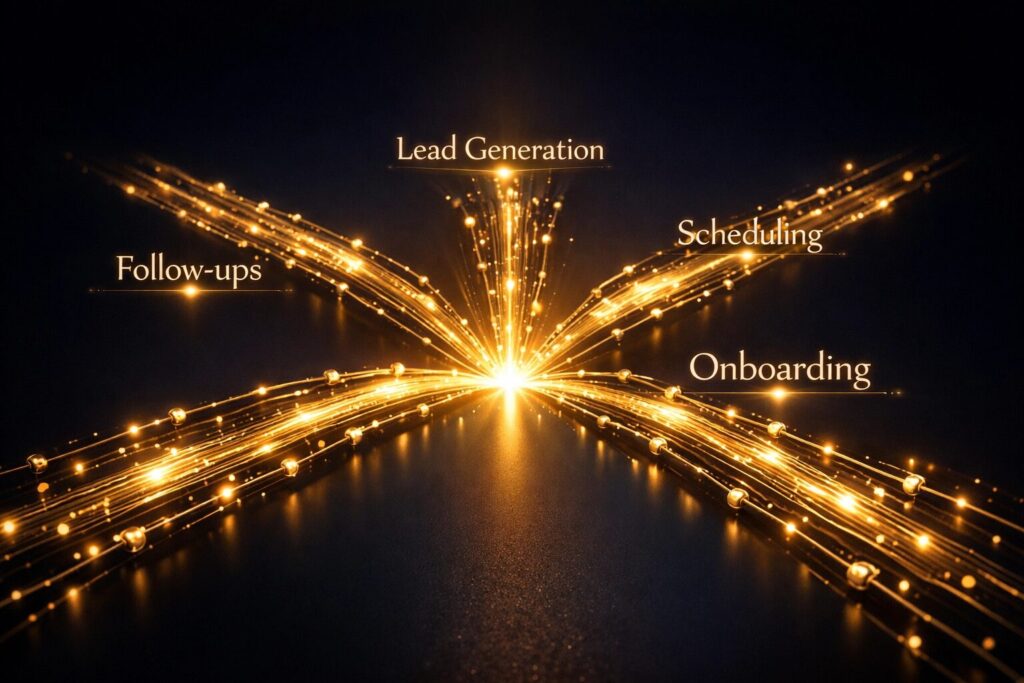
These aren’t sexy. They won’t look impressive on Instagram. But they’re the difference between running your business and your business running you.
The Energy Depletion Problem
Here’s what took me embarrassingly long to realise: when I was avoiding building systems for lead generation, it wasn’t because I didn’t know how. It was because I was already so depleted by doing it manually that I had nothing left to fix it.
This is the cruel irony of systemisation. The tasks that most desperately need systems are the ones draining you too much to create those systems.
It’s not a skill gap. It’s an energy gap.
You know what needs fixing. You probably know roughly how to fix it. What you don’t have is the bandwidth to think clearly enough to build something that actually works instead of creating yet another system that looks good but doesn’t function.
Sound familiar? You’re not alone. And you’re not failing. You’re just stuck in a loop where the problem prevents its own solution.
The One Question That Changes Everything
Before you build another system, ask yourself this:
“Is this relieving pressure or soothing discomfort?”
Relieving pressure removes actual weight from your day. It frees up time, energy, or attention that you can redirect elsewhere. You can feel the difference in your nervous system: there’s space where there wasn’t before.
Soothing discomfort makes you feel better without changing your reality. It’s emotional relief without practical relief. It’s the sock drawer at 11pm.
Both are valid. But only one is sustainable.
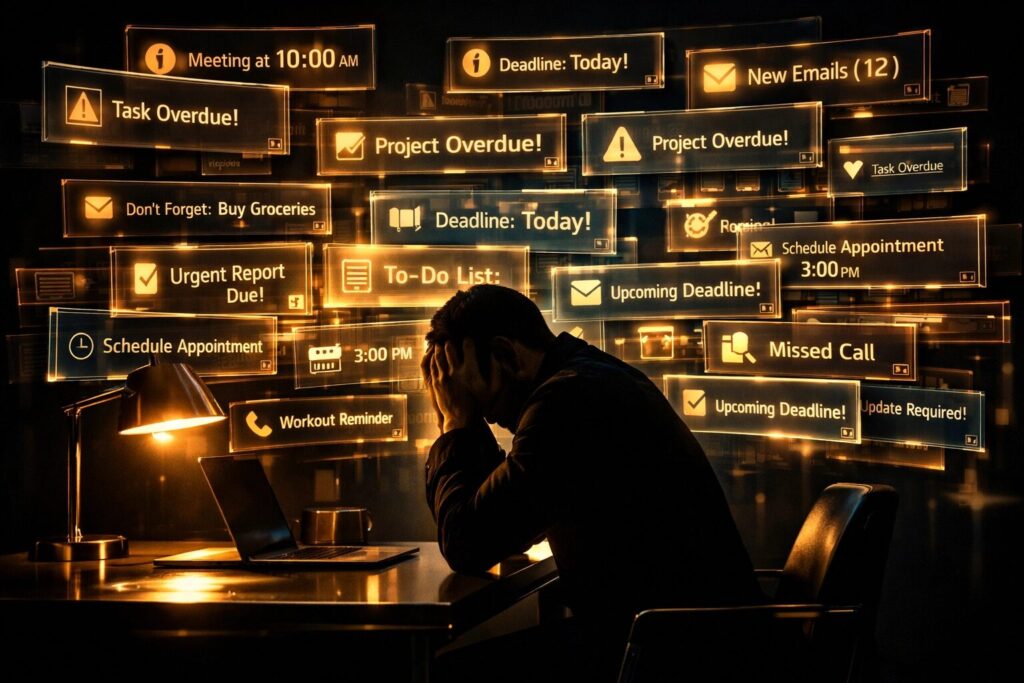
When you’re tempted to redesign your brand colours for the third time this year, pause. What pressure would that relieve? What time would it give you back? What would it allow you to stop thinking about?
If the answer is “none,” you’re soothing discomfort.
And that’s fine: sometimes we need soothing. But let’s not confuse it with solving.
Start Where It’s Relentless
The right place to systemise isn’t the thing that looks the messiest. It’s the thing that’s quietly, consistently, relentlessly draining you.
It’s the task you do every single day that makes you sigh before you start. The thing you’d pay someone to handle if you could afford it. The process you keep meaning to document but never do because you’re too busy doing it.
That’s your starting point.
Not your logo. Not your dashboard. Not the elaborate workflow for something that happens twice a year.
The boring, repetitive, necessary thing that’s eating your life in fifteen-minute increments.
If you’re stuck between “I know what needs fixing” and “I can’t think clearly enough to fix it,” you might benefit from talking it through. We’re running a live system-mapping session where we’ll identify exactly which systems will give you the most relief: and which ones are just pretty procrastination. Sometimes you just need someone to point at the right drawer.